

Hardness, flexural and impact tests carried out by Applus+ on Resistone EX Ground.
Resistance to water and chemicals
Most microcements are hydrophilic: they absorb water. If the varnish has a pore or a scratch, liquid gets in and stains the mortar for good. Resistone EX resists water even before sealing, so a local failure of the varnish does not turn into a stain. That is why we recommend it for shower trays, washbasins and bathrooms.

Compressive strength
This measures how well the surface takes concentrated pressure: dropped objects, heels, chair legs. Resistone EX has a very high surface hardness (184 N/mm²), while the lower layers keep some flexibility so they do not crack.
One precaution: heavy furniture with thin legs concentrates a lot of weight on a very small area. It is a question of weight versus contact area; use wide protective pads.
Scratch and abrasion resistance
- Scratching: deep damage from a sharp object. It is assessed visually.
- Abrasion: wear from repeated rubbing. It depends mainly on the sealer. Ours loses 19 mg in the Taber test (CS17, 1,000 cycles, 1,000 g).
Crack resistance
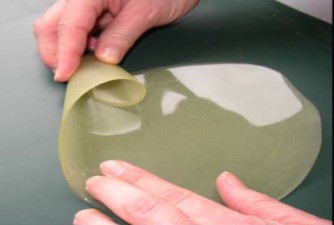
A modern microcement does not crack on its own. Cracks appear when the substrate moves (concrete, tiles, plaster). The key is for the base coats to be elastic and absorb that movement. Our highest-performance base, EP-Elastic, has a tensile strength of 15 N/mm² and an elongation at break of 110 %.
Adhesion
This is critical outdoors and in pools, where moisture and sun create vapour pressure under the coating. With EP Humid Primer, the pull-off test on damp concrete breaks in the concrete, not at the bond.
Fire and heat
It contributes less to fire than a laminate floor and is more resistant than wood; ceramic tiles are still better on this parameter. Class B-s1, d0 (EN 13501-1): very limited contribution to fire, little smoke and no flaming droplets. It withstands a hot pan and can be used to clad fireplaces.